













How Polyphenols Shape Tea from Matcha to Rooibos
Tea leaves are packed with polyphenols, the family of plant compounds behind much of a tea's colour, astringency, bitterness and body. Which polyphenols a cup holds, and how many, depends on the type of tea, how the leaf was processed and how you brew it. This post explains the chemistry of tea polyphenols, compares how they differ from matcha to rooibos, and shows how processing and brewing change what you taste.
At Valley of Tea, we have been sourcing and tasting teas for over fifteen years. This guide draws on that experience.

What Are Polyphenols in Tea?
Polyphenols are not one substance. The word covers a large group of plant compounds that share a chemical structure: several phenol rings joined together. Plants make them in their leaves, fruit and bark, and the tea plant, Camellia sinensis, makes a great many of them.
Polyphenols: The Broad Category
Tea contains thousands of identified polyphenolic compounds, though only a fraction of them are present in significant quantities. Together they shape much of what you notice in the cup: the colour of the liquor, the drying feel on the tongue, the bitterness and the weight of the brew. They are also the compounds tea chemists study most.
The total polyphenol content of dried tea leaves ranges from roughly 20 to 35 percent by weight, depending on the cultivar, growing conditions, harvest timing and processing method.
Catechins: Green Tea's Signature Compounds
Catechins are a subgroup of polyphenols called flavan-3-ols. They dominate in green and white tea because light processing leaves them in their original form. The four major catechins in tea are epicatechin (EC), epicatechin gallate (ECG), epigallocatechin (EGC) and epigallocatechin gallate (EGCG).

EGCG is the most abundant. It typically accounts for 50 to 80 percent of the total catechins in green tea, and it is a large part of the brisk, slightly bitter edge that a freshly brewed green tea has. When a green tea tastes grassy and lively with a firm finish, catechins are doing much of that work.
Flavonoids, Theaflavins, and Thearubigins
Flavonoids are a broader class that includes catechins. All catechins are flavonoids, but not all flavonoids are catechins. Tea also contains other flavonoid subgroups, including flavonols such as quercetin and kaempferol.
When tea leaves are oxidized during processing, as in the production of oolong and black tea, catechins are converted by the leaf's own enzymes into theaflavins and thearubigins. Theaflavins give black tea its bright amber colour and brisk taste. Thearubigins are darker, larger compounds that add body and depth to the cup.
Oxidation does not remove polyphenols from the leaf; it turns them into different ones.

Polyphenols Across Tea Types
Not all teas carry the same polyphenol profile. Growing conditions, processing and the part of the plant used all create real variation, and you can taste much of it. Here is how the main types compare.
Matcha
Matcha is stone-ground whole green tea leaf, and that is the key difference. When you drink matcha, you take in the entire leaf rather than water that has steeped it. A standard serving of matcha is often cited as holding two to three times more EGCG than a cup of steeped green tea, and more again when more powder is whisked.
The shade-growing period before harvest (typically 20 to 30 days under cover) raises chlorophyll and L-theanine levels and changes the catechin profile, which is why good matcha is deep green and less bitter than its catechin content would suggest. Ceremonial grade matcha from the first spring harvest tends to have the highest overall quality, while culinary grades are more robust and better suited to baking and lattes.
Green Tea (Loose Leaf)
Standard steeped green tea, whether Chinese pan-fired styles like Dragon Well or Japanese steamed teas like Sencha, is the tea category whose catechins have been measured most often. A typical cup brewed at 70 to 80 degrees Celsius for two to three minutes contains roughly 50 to 100 milligrams of EGCG, plus other catechins. A comparison of commercially available green teas published in Plant Foods for Human Nutrition (2023) found clear variation in catechin content across tea types and formats, with processing method playing a central role (Catechin Composition of Green Teas, Springer 2023).

Japanese steamed green teas tend to test slightly higher in catechin content than Chinese pan-fired greens. Steaming preserves catechins more effectively than the higher-temperature wok firing, which also explains the difference in taste: steamed teas are greener and more vegetal, pan-fired teas nuttier and toastier. Among Japanese greens, fukamushi (deep-steamed) Sencha releases more into the brew because the longer steaming breaks up the leaf, so it extracts faster and gives a cloudier, fuller cup. Our Gunpowder Green Tea is a classic Chinese pan-fired style: bold, with a firm, slightly smoky character.
Gyokuro, Japan's shade-grown green tea, is an interesting case. The shading period lowers catechin levels (the plant makes more catechins as a response to sunlight) and raises L-theanine. Gyokuro has a different polyphenol profile rather than simply a higher or lower one, and that is a large part of its rounded, savoury taste.
I brew our Premium Gyokuro at around 60 degrees Celsius: at that temperature the umami and sweetness come through beautifully. Go higher and you start pulling more astringency, and the delicate buttery, seaweed quality that defines a good Gyokuro gets lost.
White Tea
White tea undergoes the least processing of any tea type: the leaves are simply withered and dried, with no kill-green step and no rolling. This light handling leaves a high catechin content in the leaf. Several studies have found that certain white teas, particularly Silver Needle (Bai Hao Yin Zhen) made from young buds, contain catechin levels comparable to, or even above, those of some green teas.

The catch is that white tea is usually brewed at lower temperatures and for a short time, so less of what is in the leaf reaches the cup. That is part of why white tea tastes so soft. Changing the brew (covered in the brewing section below) shifts that balance. Our White Peony is a good entry point: made from young buds and first leaves, it gives a clean, gentle cup with a floral character.
Oolong Tea
Oolong covers a wide spectrum, from 15 to 85 percent oxidation, and its polyphenol profile varies with it. Lightly oxidized oolongs like high-mountain Taiwanese teas (Ali Shan, Li Shan) keep more catechins and sit closer to green tea, both in their chemistry and in their fresh, floral taste. Heavily oxidized oolongs like Da Hong Pao shift toward theaflavins and thearubigins, placing them closer to black tea, with darker fruit and mineral notes.
Oolong also contains partially oxidized polyphenols found in neither green nor black tea, which gives it a chemistry of its own. Our Tie Guan Yin is a lightly oxidized oolong with a floral, green profile and a creamy texture.
Hibiscus Tea
Hibiscus (Hibiscus sabdariffa) is not a true tea, it contains no Camellia sinensis, but its polyphenols are worth a place here because you can see them. Hibiscus is rich in anthocyanins, the pigments that give the infusion its deep red colour, and in the acids that give it a tart, cranberry-like taste.

In several comparative studies, the total polyphenol content of hibiscus infusions has been measured at levels comparable to green tea. Hibiscus is also naturally caffeine-free.
Rooibos
Rooibos (Aspalathus linearis) is another caffeine-free plant with a polyphenol profile of its own, different from Camellia sinensis teas. Rooibos contains aspalathin and nothofagin, two flavonoids that are specific to this plant and found in no other widely consumed food or drink.
Green (unoxidized) rooibos contains more aspalathin than traditional red (oxidized) rooibos. The oxidation that gives red rooibos its colour and sweeter, honeyed flavour converts some aspalathin into other compounds. Green rooibos tastes lighter, grassier and more herbal as a result. Our Green Rooibos is unoxidized and keeps that fresh character.
How Processing Affects Polyphenol Content
Tea processing is the single biggest factor deciding which polyphenols end up in your cup. The same Camellia sinensis leaf can become green tea, oolong or black tea depending entirely on how it is handled after harvest.

Oxidation
Oxidation is the main process that transforms tea polyphenols. The enzyme polyphenol oxidase, released when leaf cells are bruised or rolled, converts catechins into theaflavins and thearubigins. In green tea, this is stopped almost immediately with heat (pan-firing or steaming). In black tea, it is allowed to run its course over several hours.
The practical result: green tea keeps 60 to 80 percent of its original catechins, while black tea keeps only a fraction. The missing catechins are not lost but converted into theaflavins and thearubigins, and that conversion is what turns a green, grassy leaf into a malty, amber cup.
Roasting and Firing
Heat treatment beyond the initial kill-green step also affects polyphenol content. Heavily roasted oolongs and hojicha (roasted Japanese green tea) have lower catechin levels than their unroasted equivalents. The Maillard reaction that produces the toasty and caramel flavours breaks down some of the polyphenols along the way.
Roasted teas still contain polyphenols, just fewer catechins, which is why hojicha and dark roasted oolongs taste smooth and hardly astringent compared with a fresh green tea.

Aging
Aged teas like pu-erh undergo microbial fermentation over months or years. This changes the polyphenol profile again, creating compounds such as theabrownins that are specific to aged teas. Aged pu-erh has fewer catechins than fresh green tea and a dark, earthy cup. Our Aged Pu-erh represents this category: a deeply fermented tea with a character quite different from green tea.
How Brewing Changes What Ends Up in the Cup
The polyphenols in the dry leaf are only part of the story. How you brew decides how much of them reaches the water, and with that, how the tea tastes.
Temperature
Hotter water extracts more polyphenols. Measurements show that brewing at 90 to 100 degrees Celsius extracts clearly more catechins than brewing at 60 to 70 degrees. Hotter water also pulls out more caffeine and more bitter compounds, which is why delicate green teas are traditionally brewed cooler.
For most green teas, 80 to 85 degrees Celsius is a reasonable middle ground: hot enough for a full-flavoured cup, cool enough to keep bitterness in check.

Steeping Time
Polyphenol extraction increases with steeping time, but not in a straight line. Most catechins come out in the first three to five minutes. Steeping longer still draws out more, but at a slower rate, while bitterness and astringency keep climbing.
A three-minute steep at the right temperature extracts roughly 60 to 70 percent of the available catechins. A five-minute steep gets closer to 80 percent. Beyond that, the cup mainly becomes more tannic.
Leaf-to-Water Ratio
More leaf per cup of water gives a more concentrated brew. Loose leaf tea generally extracts more evenly than tea bags because the leaves have room to unfurl and expose more surface. Finely ground tea like matcha goes furthest, because the whole leaf ends up in the bowl.
Multiple Infusions
For teas brewed gongfu style with several short infusions, the first and second steeps carry the most polyphenols. Each infusion pulls different compounds: the first is the most intense, with the most astringency. By the third and fourth steep the tea becomes noticeably milder and sweeter: that shift in character is the principle behind gongfu brewing.

Short infusions bring out different flavours than one long steep, and taken together, a series of steeps can draw more from the leaf than a single long one, because each round of fresh hot water keeps extracting.
Comparing Teas by Polyphenol Profile
Comparing teas by polyphenols is less simple than it looks, because the answer depends on what you count: total polyphenols, a single catechin like EGCG, or the products of oxidation such as theaflavins.
The broad picture is consistent, though. Matcha holds the most catechins per serving because you drink the whole leaf. Among steeped teas, green tea (particularly Japanese steamed teas) has the most catechins, with white tea close behind and sometimes ahead, depending on cultivar and processing.
Oolong sits in the middle, its position set by how far it was oxidized. Black tea has the fewest catechins but the most theaflavins and thearubigins. Among caffeine-free infusions, hibiscus has the highest total polyphenol content, followed by green rooibos.
If someone asks me where to start with green tea, I point them to a good Japanese Sencha. It is refreshing and forgiving to brew, which makes it an easy tea to come back to. From there, the next step is Gyokuro: less than one percent of Japan's production, and the shading concentrates L-theanine and chlorophyll in the leaves.
Matcha is often the first suggestion people expect, but Sencha is the easier everyday cup, and the one I would recommend first.
Related Articles
Leave a comment
Comments will be approved before showing up.
Also in Valley of Tea Blog | Tea Guides, Origins & Brewing Tips
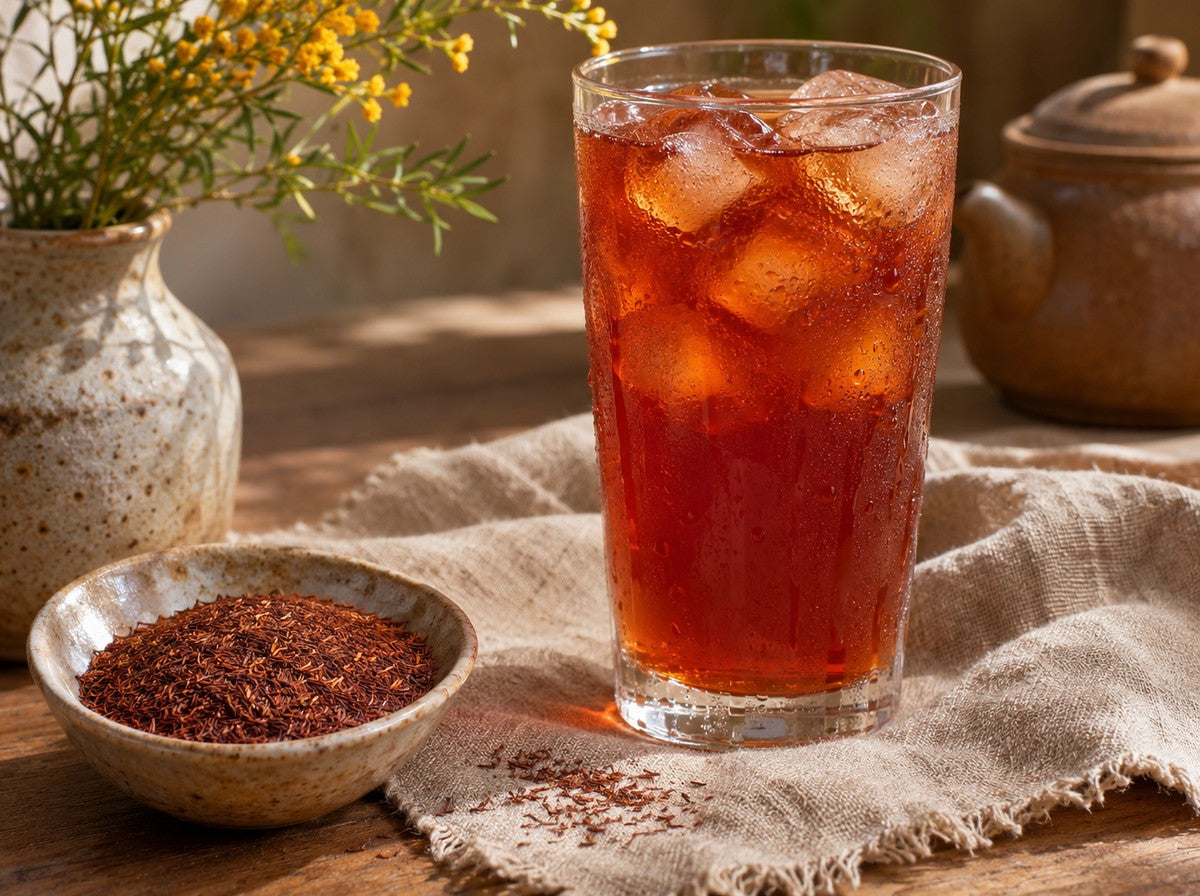

Rooibos Iced Tea: Caffeine-Free Refresher
Learn to make rooibos iced tea two ways: hot-brewed over ice in 15 minutes, or a smoother overnight cold brew, plus flavour additions and storage tips.

Spice Cabinet Organization: A Practical System That Works
Learn how to organize your spice cabinet with a practical system that keeps every jar findable and fresh. Temperature, layout, and audit tips included.

Maca or Ashwagandha for Your Daily Routine
Choosing between maca or ashwagandha? Learn how each root tastes, when to use them, and the best ways to prepare each in tea or drinks.

Wisdom is the path to better tea.
Get our free brewing guide: the right water, heat and timing for every tea we sell. You will also hear it first when new harvests arrive.
No spam. Unsubscribe any time.
Check your inbox.
The guide is on its way.